
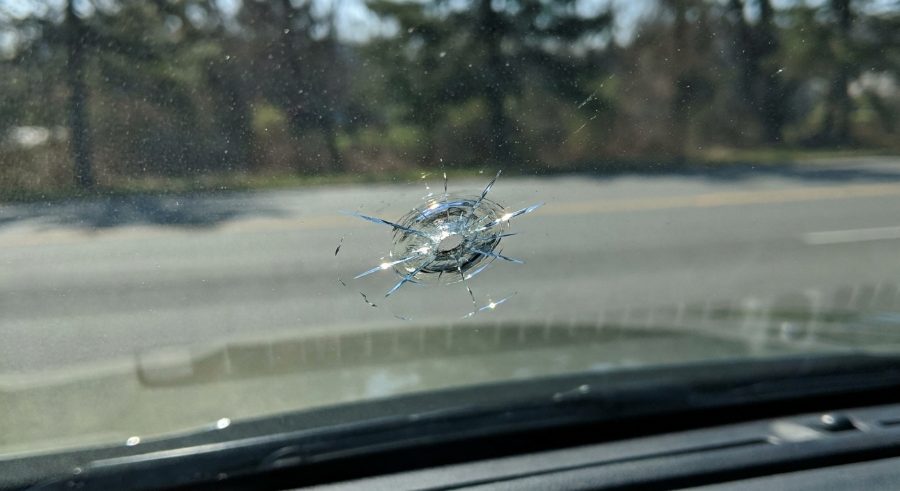
A crack does not spread at a steady rate. It sits still for days and then travels four inches across the glass in a single afternoon, and the afternoon it picks is almost always a hot one. If you are waiting on an appointment, the job between now and then is to keep the glass out of the conditions that make it move.
Six things genuinely help. Four things people try make it measurably worse. Here is which is which, and why the Fresno Valley is a harder place to run out the clock than most.
What Actually Moves a Crack
A windshield is two sheets of glass bonded to a plastic interlayer. A crack in the outer sheet is a stress concentration — a place where any force applied to the panel gets focused into a single point at the crack tip. Three forces do the applying:
- Temperature difference across the glass. Not heat itself — the difference between the inner and outer face. Glass expands as it warms, and when one face expands faster than the other the panel puts itself under tension. This is far and away the biggest factor here.
- Vibration and flex. Every expansion joint on Highway 99, every patched section of Blackstone or Belmont, every dirt turn-row out past Sanger sends energy through the body shell and into the glass.
- Moisture in the break. Water wicks into the crack by capillary action, then expands or evaporates with temperature. It also carries dirt in, which is the thing that makes a repair fail later even if the crack stops moving.
Six Things That Actually Help
- 1. Park in shade, or use a reflective shade. This is the highest-value thing on the list and it costs nothing. A windshield in full Fresno sun in July runs well past 170°F on its inner face while the outer face is cooler — that gradient alone is enough to walk a crack across the glass in an afternoon. A garage, a carport, the shaded side of the building at work, or a folding reflector in the glass: any of them cuts the gradient sharply.
- 2. Bring the cabin down gradually. Getting into a 140°F car and putting the air conditioning on maximum straight at the windshield is the single most common way a repairable chip becomes a replacement in this valley. Open the doors or drop the windows for a minute first, then start on low and aim the vents at the floor. Give it five minutes before you point cold air at hot glass.
- 3. Do the same thing in reverse during fog season. From November into February the valley sits under tule fog and every windshield is cold and wet in the morning. Defroster on full against that glass is the same shock with the sign flipped. Start low, let it come up, and clear the outside with the wipers rather than asking the heater to do all of it.
- 4. Put clear tape over the break — on the outside only. A piece of clear packing tape keeps dirt and water out of the crack until a technician can get to it. It does nothing structurally, but it protects the repair: resin bonds to clean glass, and a break that has been collecting road grime for two weeks may no longer take a repair at all.
- 5. Slow down for the rough stretches. You cannot avoid every patched section of pavement in this city, but you can take them at 45 instead of 60. Vibration load rises sharply with speed, and the difference on a crack that is already close to moving is real.
- 6. Book it now, drive on it after. A crack that is going to be repaired on Thursday is a crack you only have to nurse until Thursday. The list above buys days, not weeks.
Four Things That Make It Worse
- 1. Hot water on a cold windshield. On a foggy January morning in the valley this is tempting and it is the fastest way to turn a cracked windshield into a shattered one. Even undamaged glass sometimes does not survive it.
- 2. The drive-through car wash. High-pressure jets, mechanical flex from the track, and a hot-to-cold swing all at once. If the car needs washing, do it by hand with ambient-temperature water and keep the pressure off the damage.
- 3. Rear defroster on a cracked rear window. The heating grid puts heat into narrow lines. A crack crossing those lines gets a steep local gradient exactly where the glass is weakest.
- 4. A drugstore resin kit, used badly. On a clean, fresh, small chip these sometimes work. On a crack they do not, and a kit cured at the wrong depth or over a dirty break can leave the damage unrepairable by a technician who could otherwise have saved it. That turns a $0-deductible chip repair into a windshield.
When to Stop Nursing It and Stop Driving
Some damage is past managing. Call rather than wait if the crack is in your line of sight, longer than about three inches, touching the edge of the glass, or branching in more than one direction. The same is true if you can feel any flex or hear any movement in the glass over bumps.
There is a legal dimension too: under California Vehicle Code §26710, damage in the wiper-swept area is a correctable violation, which means a fix-it ticket and an inspection signature on top of the repair.
The Honest Timeline
In a mild coastal climate a stable crack might hold for weeks. Here it usually does not. Between summer afternoons above 100°F and winter mornings that start under fog, a Fresno windshield gets a full thermal cycle nearly every day of the year, and each one works the crack tip a little further.
Mobile appointments across Fresno, Clovis, Madera, Selma, Sanger, Reedley and Kerman are usually available same-day or next-day, and a chip repair costs a fraction of a replacement. Call (559) 354-3674 and we will tell you on the phone which one you are looking at.
Need Service in the Fresno Metro?
We provide mobile windshield repair and replacement throughout Fresno, Madera, Selma, Kerman, Reedley, Clovis, and Sanger. Call now or fill out the sidebar form for a free estimate.
Call (559) 354-3674