
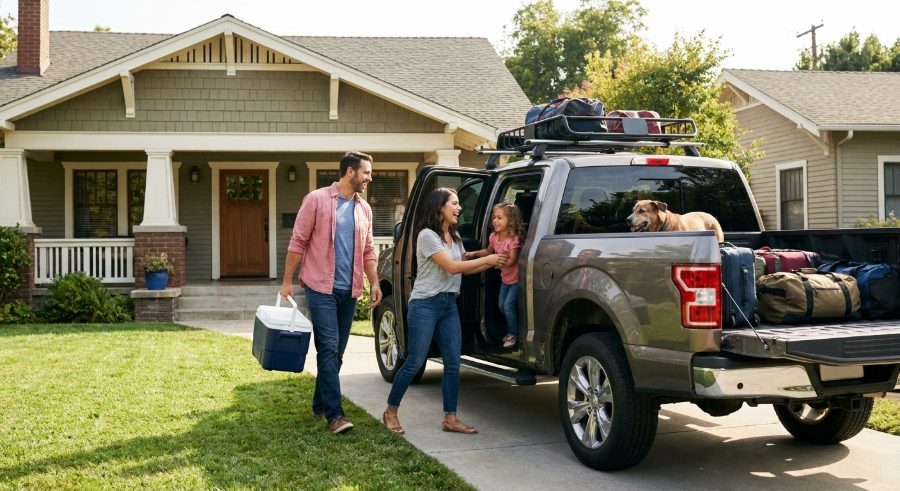
Fresno is a good place to start a drive and a hard place to start one on damaged glass. Almost every route out of here climbs, and every climb is a temperature swing: the 99 south to the Grapevine, the 41 up toward Oakhurst and the Yosemite gate, the 168 to Shaver, the 180 east to Kings Canyon, the 152 over Pacheco to the coast. A chip that has sat quietly in a driveway in Bullard for a month can open up in the first hour of any of them.
Fifteen minutes in the driveway before you load the car is the whole intervention. Here is what to look at.
The Pre-Trip Auto Glass Inspection
Stand outside and look across the glass from several angles, then again from the driver’s seat. Low sun catches stress lines that vanish under overhead light. Fresno drivers pick up more chips than they notice — most of them come off the 99 and never get looked at.
Anything under a quarter and out of your sightline is repairable today and probably not repairable after a run over the Grapevine. Elevation change plus 100-degree pavement is the exact combination that walks a chip into a crack.
Run a finger around the perimeter looking for lifted trim or gaps in the urethane. A compromised seal whistles at 70, leaks in the first rain over Pacheco Pass, and means the glass is not carrying load the way the body expects it to.
Valley dust and bug spatter build up fast on a summer drive, and a dry wiper drags grit across the glass. Top the reservoir before you go — running dry behind a truck on I-5 with low sun ahead of you is genuinely dangerous, not just annoying.
Check the rear window for chips and look at the defroster lines. A crack crossing a heating line spreads quickly once you switch the grid on, which you will the first foggy morning on the way home.
Run each one fully down and back up. Listen for grinding and watch for judder. Look along the bottom edge where the glass meets the door — that is where chips hide.
Tap each housing. Anything that rattles at a standstill will blur at highway speed, which matters most in exactly the situation you bought the mirror for: merging onto a busy 99 with a loaded car.
Open and close it once. Check the glass edges for chips, and pour a little water into the channel to confirm the drains run. A blocked sunroof drain finds the headliner on the first mountain rainstorm.
Why Leaving Fresno Is Harder on Glass Than Driving In It
City driving is comparatively gentle on a windshield. The routes out of the valley are not, and they stress glass in ways that stack:
- Elevation, and the temperature that comes with it. The Grapevine tops out above 4,000 feet and the 168 climbs past 5,000 on the way to Huntington. Leaving a 105°F valley floor and arriving somewhere 30 or 40 degrees cooler puts the glass through a bigger swing in two hours than it normally sees in a week.
- Freight, and what comes off it. Highway 99 and I-5 carry a large share of California’s north–south truck traffic, and the 99 in particular runs a constant mix of gravel, produce and equipment haulers. At 70 mph a stone that would have chipped paint in town takes a divot out of laminated glass.
- Surface changes. A mountain run means interstate, then two-lane state route, then a national park road with a gravel shoulder. Each transition drops loose material onto the pavement, and the vehicle in front of you throws it.
- Winter on either end. Chain control on the 168 and the 41 means stop-start crawling behind vehicles flinging slush and grit. Down here the same months bring tule fog on the 99 and I-5, and a defroster on full against cold glass is its own kind of stress.
If You Take a Hit on the Road
Damage away from home is mostly a matter of not making it worse before you can get it looked at:
- Get it into shade at the next stop. A rest area with trees, the shaded side of a building, anything. Sun on a fresh chip is the fastest way to lose the repair.
- Bring the cabin down gently. Coming off a hot pass and blasting the air conditioning at the windshield is the classic way to turn a chip into a crack on the drive home.
- Cover it with clear tape. Packing tape over the outside keeps road grime and water out of the break. It does nothing structurally, but it is often the difference between a repairable chip and one that has to be replaced because the break is dirty.
- Skip the car wash on the way back. Whatever the car picked up can wait until the glass is fixed.
- Decide honestly whether to keep driving. A small chip outside your sightline can finish the trip. A crack in your line of sight, past three inches, or reaching the edge should not — and under California Vehicle Code §26710 it is a correctable violation as well as a safety problem.
Fix It Before You Go, Not After
A chip repair takes about half an hour, costs a fraction of a windshield, and is the one job on this list that gets harder the longer you leave it. A chip that goes over the Grapevine and back frequently comes home as a replacement.
We can meet you at home before an early start, or at work the day before, anywhere across Fresno, Clovis, Madera, Selma, Sanger, Reedley and Kerman. Call (559) 354-3674 and we will get it done before the car is loaded.