
It usually happens the same way here. You are northbound on Highway 99 somewhere between Fowler and the Belmont exit, boxed in behind a gravel truck or a bin trailer running out of the orchards, and something comes off the load. A tap you feel more than hear. By the time you are parked at work there is a star in the glass the size of a dime.
What you do in the next few hours decides whether this is a thirty-minute resin repair or a full windshield. In the Fresno Valley that window is shorter than most drivers expect, for reasons that have everything to do with where we live.
The First Sixty Seconds
If it happens while you are moving, the glass is not about to fall in on you. Laminated windshields are two sheets bonded to a plastic interlayer, and the interlayer holds. So do not brake hard or swerve — both send exactly the kind of flex through the body that pushes a fresh chip outward.
Ease off the accelerator and let the car slow on its own. If you are on the 99, the 41 or the 180, take the next exit rather than the shoulder; those shoulders carry a lot of debris and a lot of speed. On an arterial like Blackstone, Shaw or Kings Canyon Road, a parking lot is thirty seconds away and is the better choice.
Then turn the climate control down. This is the part almost everyone gets wrong, and in this valley it is the part that costs the most.
Why Fresno Is Unusually Hard on a Fresh Chip
Two local conditions do more damage to cracked glass than the original impact did.
- Summer heat, and what you do about it. Fresno spends most of June through September above 100°F, and a windshield parked in that sun runs far hotter than the air around it — the inside face routinely passes 170°F. Get in, start the car, aim the air conditioning straight at the glass, and you have just put a 100-degree difference across a panel that already has a weak point in it. That single act turns more repairable chips into replacements here than anything that happens on the road.
- Tule fog, and what you do about that. From November into February the valley floor sits under fog for days at a stretch, and the first thing every driver does is put the defroster on full against a cold windshield. Same physics, opposite direction. A chip that survived the summer often finishes spreading on a January morning in a driveway in Sunnyside or Bullard.
The rule in both seasons is the same: bring the glass to temperature gradually. Low fan, moderate setting, give it five minutes. Crack a window in summer to let the cabin dump heat before you ask the air conditioning to do it all at once.
Is It Still Legal to Drive?
This is worth knowing before you decide to wait a week. Under California Vehicle Code §26710, damage in the area swept by the wipers is a correctable violation — an officer can write it as a fix-it ticket, which means an inspection signature and a trip to the courthouse on top of the repair you were already going to pay for.
Set the legal question aside and there is a practical one. Stop driving and call if the crack sits in your line of sight, runs longer than about three inches, reaches the edge of the glass, or has started to branch. Any of those and you are no longer deciding between repair and replacement — you are deciding how long to drive on compromised glass.
Chip, Crack, or Edge Crack
Three kinds of damage, three different outcomes:
- A chip is a single impact point, usually a quarter or smaller, where the outer layer has lost a fragment. Caught early and away from your sightline, this is a resin injection — half an hour, and the glass keeps its factory seal.
- A crack is a line running out from an impact, or one that appeared on its own from thermal stress. Past roughly three inches, resin cannot restore the structure and the windshield is replaced.
- An edge crack starts within about two inches of the perimeter. It is a replacement almost regardless of length, because the edge is where the glass is bonded to the body and carries load in a rollover.
Four Things That Make It Worse
- The car wash. High-pressure jets and the flex of the track are hard on damaged glass, and the temperature swing from hot pavement to cold water does the rest.
- Rough pavement at speed. Blackstone Avenue and the older sections of Belmont and Olive will find a crack that Highway 41 never would. If you have to drive, slow down for the bad stretches.
- Leaving it parked in full sun. A shaded spot or a reflective sunshade is genuinely worth the trouble here — it keeps the inner face of the glass tens of degrees cooler.
- Over-the-counter resin kits. They can work on a clean, small chip. Used badly they cure resin into the break at the wrong depth, and a technician can no longer do the repair properly — which turns a repairable chip into a replacement.
What Your Insurance Actually Covers in California
Worth two minutes on the phone before you pay out of pocket, but go in with the right expectation. Glass damage is paid under comprehensive coverage, not collision. Your deductible applies to a replacement — California, unlike Florida, Arizona and Kentucky, has no zero-deductible glass law, and any shop that tells you otherwise is guessing.
The useful part is the other half: many carriers waive the deductible on a chip repair, because a thirty-minute repair costs them far less than the replacement it prevents. That is the single best reason to call about a chip the same week you get it rather than the month after.
Getting It Fixed Without Losing a Day
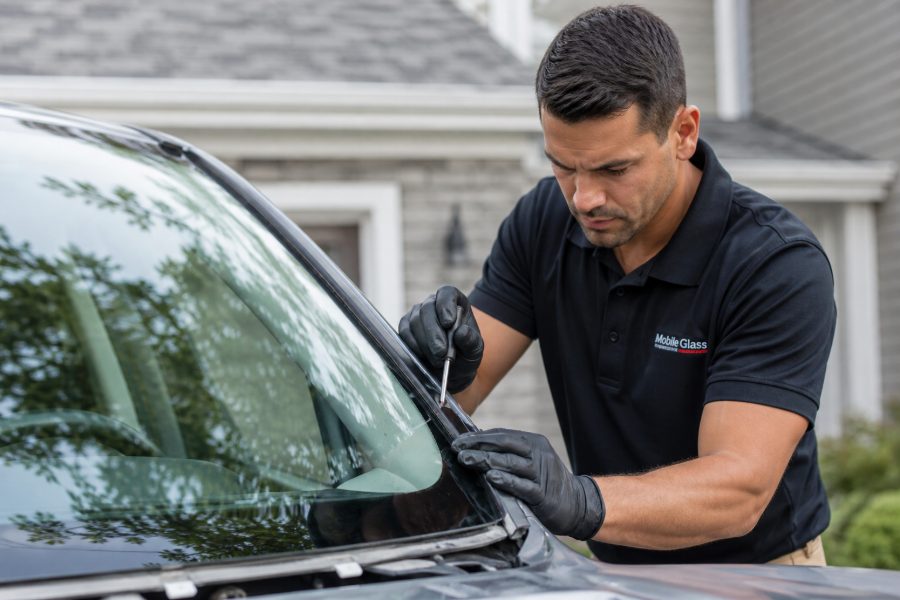
The reason mobile service fits this problem is that the alternative is driving across town on the glass you are trying to protect. A technician comes to a driveway in Clovis, an office lot off Herndon, a packing shed in Reedley, a school lot in Sanger — wherever the car already is.
Chip repairs run about 30 to 45 minutes. Full replacements take 60 to 90, plus a short cure window before you drive. Call before noon and same-day is usually available across all seven cities we cover. Call (559) 354-3674 and we will tell you over the phone whether it is likely a repair or a replacement.
If Your Car Has ADAS
Anything recent enough to have lane-keep assist, adaptive cruise or automatic emergency braking is reading the road through a camera mounted at the top of the windshield. Replace the glass and that camera has to be recalibrated — it is not optional, and a camera that is off by a fraction of a degree at the windshield is off by a lane width at distance.
Mention it when you book. It changes how long the appointment takes and occasionally where it has to happen, and it is a much better conversation to have beforehand than after the install.
Need Service in the Fresno Metro?
We provide mobile windshield repair and replacement throughout Fresno, Madera, Selma, Kerman, Reedley, Clovis, and Sanger. Call now or fill out the form to the right for a free estimate.
Call (559) 354-3674